

The Fifteen Year Old Who Lost to Garry Kasparov
Hi. Take a second and think about the year 1999.
I may be aging myself here, and that is fine because I am generally an open book. If you are a hiring manager or recruiter reading this, just picture me as a young stud, head full of hair and a lust for life, with an endless personal mission to drive shareholder value.
Some of you may not have even been born yet. I was in fifth grade and absolutely thriving in JNCOs, which mostly looked like regular pants on me because I was a... uh, husky young lad.
People were on EDGE.
Slick Willie's impeachment trial started in January. (Yikes.)
Air Jordan announced his second retirement. (I literally cried.)
Jar Jar Binks was introduced to the world. (or as my lovely mother-in-law thought was named G. G. Bonks…)
Pokémania took over. Fire, plants or water? (AHHHH!)
Napster launched. (Computer viruses ran rampant)
It was a time to be alive, for those of you who weren't.

It was a tough time to be a computer, too.
Every sketchy download of "No Scrubs," "Baby One More Time," or my personal favorite, Santana and Rob Thomas' "Smooth," had a decent chance of murdering the family PC. And if your computer somehow survived Napster, it surely wasn't surviving Y2K. I mean, how could we possibly expect these machines to handle the shift from 9 to 0? Better stock up on toilet paper and water.
This golden age of dial-up also gave us one of the most underrated cultural moments of the decade: Kasparov vs. the World.
The ENTIRE WORLD.
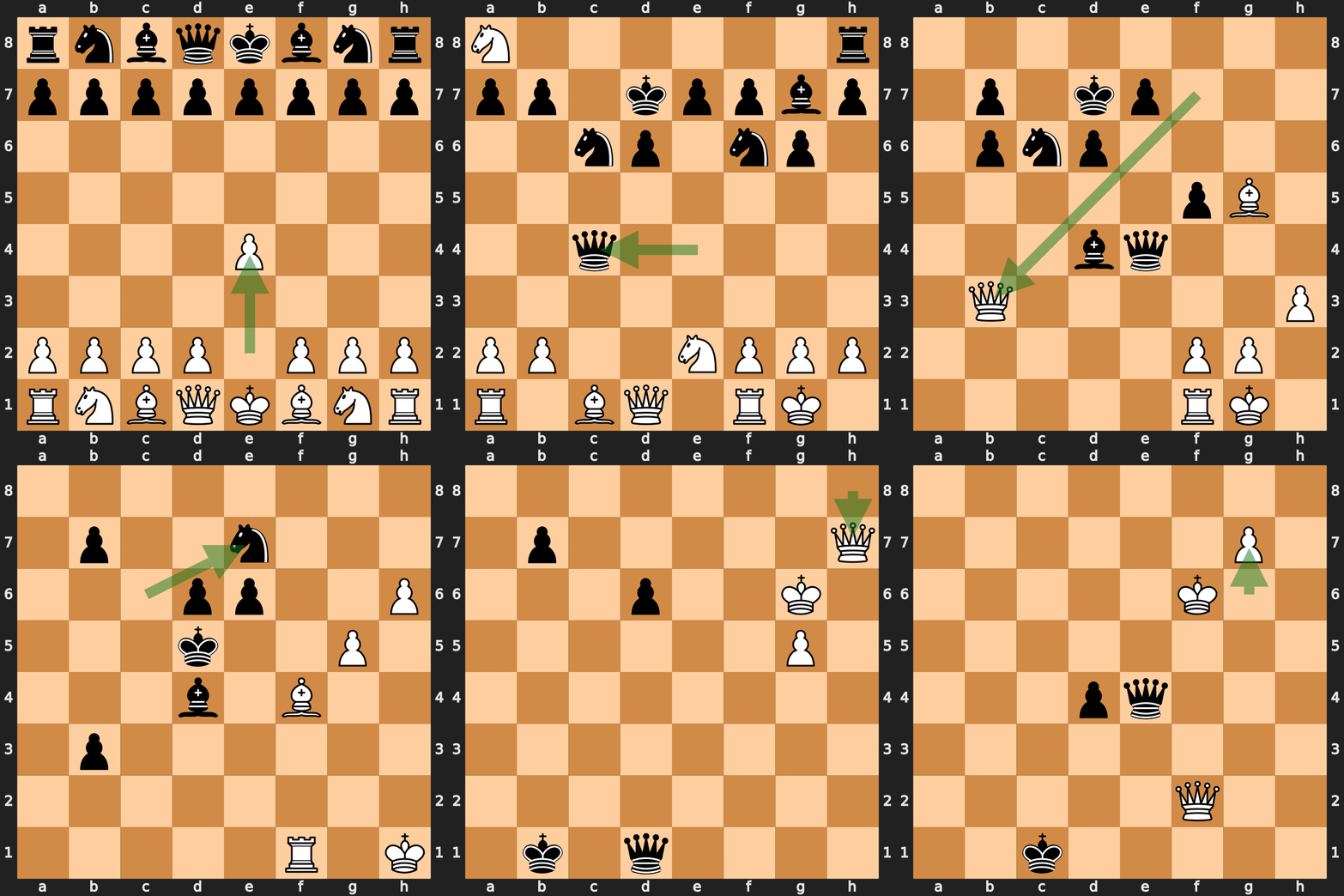
Garry Kasparov was the best chess player on earth and two years removed from losing to IBM's Deep Blue, which he was still very much not over. So when Microsoft came calling with a marketing stunt, he said yes. On June 21, 1999, Kasparov sat down to play a single game of chess against every human being with a modem.
The details are wild:
The MSN Gaming Zone (!), sponsored by First USA bank (!), hosted the match on the World Wide Web.
More than 50,000 people from over 75 countries somehow figured out how to register and vote over dial-up.
Microsoft ran an official bulletin board and appointed four teenage (?!) chess players to publicly recommend moves.
On one move, 2.4% of Team World's votes were for moves that weren't even legal.
Three of the four official analysts published their recommendations and largely stayed out of the forum. The fourth was named Irina Krush.
Krush was fifteen years old and the reigning U.S. Women's Champion. She was not the highest-rated of the four. There were grandmasters three times her age offering ideas from the sidelines. What she did instead was build a public decision tree, out in the open, where anyone could see her reasoning and argue with it. She updated it constantly. She read the forum. She replied to amateurs. She took a beating from thousands of goobers on the internet and kept posting.
It worked.
Team World voted for Krush's recommendation on every single move from 10 through 50, including times when all three of the other official analysts disagreed with her. Eventually, even stronger players began routing ideas through the fifteen-year-old because she had become the person actually organizing the conversation.
And then she got one thing spectacularly wrong.
On move 54, Krush recommended a move that later analysis showed turned a drawable position into a loss. The other three analysts had recommended moves that could have held the draw.
Womp womp.
Kasparov eventually took the dub on move 62, four months after the game started. Then he spent years thinking about it. He called it one of the most remarkable games of his career and eventually wrote a 202-page book about the thing. Riveting stuff.
I don't particularly remember any of this. Again, I was in fifth grade.
So why is a grown man in the midst of a career transition thinking this hard about a chess match he doesn’t fully remember?
I have made it to the final round more times than I'd like during this job search. Great conversations. Real excitement on both sides. Maybe a case-study or two, another call, a few references…
And then the call. (Or, even better… the generic email!)
If all I kept was the scoreboard, this search would look pretty bleak. Which is why I keep thinking about, and now writing about Irina Krush.
She lost.
Not only did Team World lose, the move that helped finally swing the game toward Kasparov was her recommendation. And somehow that makes the story more interesting to me, not less.
Two things that really stick with me:
The highest-rated people did not run the room.
There were grandmasters with better ratings. They had deeper chess knowledge and experience. Some probably had better analysis. But they published at the crowd instead of into it. Krush won the room by doing the unglamorous work nobody else wanted to do: reading everything, answering people, explaining her reasoning, and building something the crowd could organize itself around.
My marketing brain sees a real lesson in this, and it isn't "the crowd is always right." The crowd was voting for illegal moves! The crowd got better because one person built something everyone could argue against.
Brands do this backwards constantly. We grow an audience, we call it a community, and we never give people anything to push back on. An audience is 50,000 votes. The community is a decision tree that someone maintains in public, every day, while getting yelled at, mocked or judged.
For my own search, it's a similar idea. Credentials might get you a recommendation slot. Showing up consistently and being useful is what actually moves the room. That's the part of this process I can control, so that's where I'm putting my energy.
The scoreboard is the least interesting part.
Kasparov won. The result says 1-0. And then he wrote 202 pages about the opponent he beat. Clearly something more interesting happened than the scoreboard could hold.
That's the part of hiring I find genuinely backwards right now. The entire process is designed to produce a result, and almost nothing about it preserves the record. Or your dignity! Some of the best conversations I've had during this search ended in rejection. The only artifact that survives is the email.
So I've started keeping my own record. Building things in public. Moving quickly enough that the thinking is still visible. Making the reasoning arguable. Occasionally making something extremely unnecessary just because an idea won't leave me alone. It isn’t perfect, but it’s real.
That's my thinking.. at least at this 10 seconds.
Which brings me to the silly thing I made!
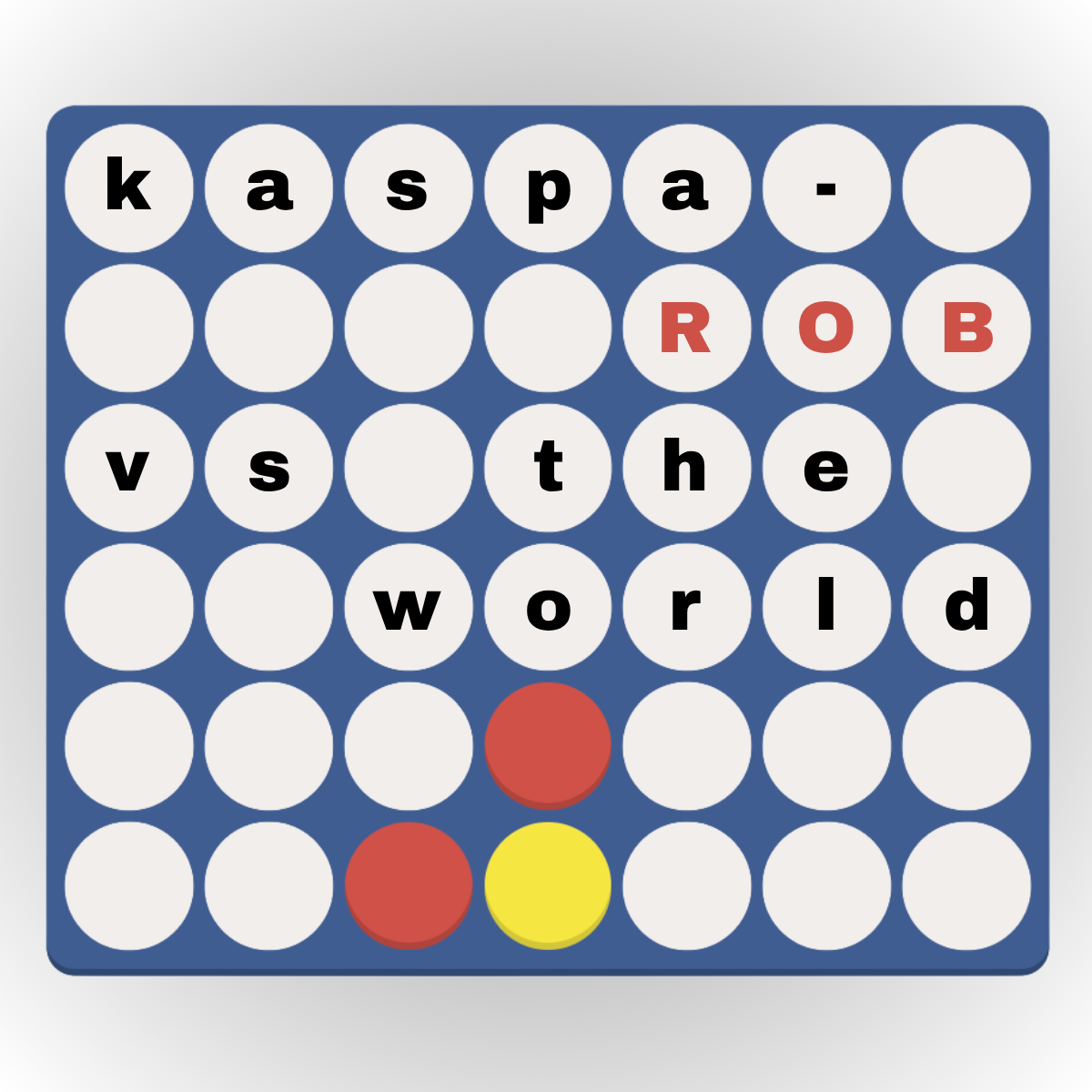
It's called kaspaROB, and it is exactly what it sounds like. I play one side. You and everyone else play the other. It's Connect 4, not chess, because I have a five-year-old and I have played roughly nine thousand games of Connect 4 this calendar year and I refuse to let that experience go to waste.
Here's how it works:
I make a move.
You get 12 hours to vote on the reply, and you can leave a one-line argument for why.
Most votes wins.
Ties go to whoever voted first. I am not very good at coding, so this seemed reasonable.
The running record lives on the page, so this is Game 1 of however many games the internet and I are willing to tolerate.
There’s a move on the board right now and the clock is running. Go make your case!